
In today’s competitive e-commerce landscape, creating a sense of urgency is crucial for driving sales. Countdown timers have emerged as a powerful tool for encouraging immediate purchases, effectively combating shopping cart abandonment and boosting conversion rates. By visually displaying a ticking clock, online retailers can tap into the psychological principle of scarcity, motivating customers to act quickly and secure a desired product or service before time runs out. This article will delve into the strategic implementation of countdown timers, exploring their benefits and providing practical guidance on how to maximize their impact in your online store.
Learn how to effectively leverage countdown timers to create urgency and drive sales. Discover optimal placement strategies, compelling messaging techniques, and best practices for integrating these dynamic tools into your online store. From limited-time offers and flash sales to pre-order deadlines and seasonal promotions, we’ll explore various applications of countdown timers to compel customers to take action. By understanding the psychology behind urgency and applying these strategies, you can significantly improve your sales performance and achieve tangible results in your online store.
Understanding the Psychology of Urgency
Urgency is a powerful psychological principle that influences consumer behavior. It taps into the fear of missing out (FOMO), prompting quicker purchase decisions. Limited-time offers create a sense of scarcity, implying that a product or deal might not be available later. This perceived scarcity increases the product’s desirability.
The principle of loss aversion also plays a key role. People are more motivated to avoid losses than they are to acquire gains. A countdown timer visually represents a dwindling opportunity, making customers feel like they are losing out if they don’t act quickly. This sense of potential loss motivates them to make the purchase before the timer runs out.
Different Types of Countdown Timers
Several types of countdown timers can be implemented to create a sense of urgency. Understanding their differences can help you choose the most effective timer for your sales goals.
Fixed-Duration Timers
These timers run for a specific period, such as 24 hours or 7 days. They’re useful for limited-time offers and creating a buzz around a new product launch. All visitors see the same countdown, regardless of when they arrive on the page.
Recurring Timers
Recurring timers reset after a specific interval. For example, a daily deal timer might reset at midnight every day. This tactic can be employed to encourage repeat purchases and maintain a consistent sense of urgency.
Product-Specific Timers
These timers are assigned to individual products and often used for flash sales or clearance items. This creates a sense of scarcity by suggesting limited stock or availability for specific items.
Visitor-Specific Timers (Session-Based)
These timers start counting down as soon as a visitor lands on the page. They create a highly personalized sense of urgency, implying that the offer is exclusive to that visitor and only valid for a short period. This tactic can be highly effective but should be used cautiously to avoid feeling manipulative.
Choosing the Right Countdown Timer for Your Products
Selecting the appropriate countdown timer is crucial for maximizing its impact. Different products and promotions benefit from various timer types. Consider these factors when making your choice:
Product Type
For limited-edition items or seasonal offers, a countdown to the end of the sale period is effective. This creates a sense of scarcity and encourages immediate purchase. Everyday products, however, might benefit from a countdown related to shipping deadlines, such as “Order within the next hour for same-day shipping.”
Sales Goal
If your goal is to clear out inventory, a countdown timer emphasizing the limited quantity remaining can be powerful. For new product launches, a timer counting down to the release date builds anticipation and excitement.
Target Audience
Understanding your target audience’s purchasing behavior can influence your timer choice. Impulse buyers may respond well to short, high-pressure countdowns, while considered purchasers might appreciate a longer timeframe.
Implementing Countdown Timers on Your Website
Adding countdown timers to your online store is generally straightforward, with several implementation options available. Choosing the right method depends on your technical skills and the platform your store is built on.
Using Plugins and Apps
For popular e-commerce platforms like Shopify, WooCommerce, and others, numerous plugins and apps offer easy countdown timer integration. These tools often require minimal coding and provide customizable timer styles and functionalities. Simply install the plugin or app, configure the settings, and embed the timer onto your desired product or landing pages.
Custom Coding
If you have coding experience or access to a developer, you can implement countdown timers using JavaScript and other web technologies. This approach provides greater flexibility in design and functionality but requires more technical expertise. Ensure your code is optimized for performance to avoid impacting page load times.
Third-Party Services
Several third-party services specialize in creating and managing countdown timers. These services often offer advanced features and analytics, but may come with a subscription fee. Consider these services if you need complex timer functionalities or require detailed performance tracking.
Best Practices for Using Countdown Timers Effectively
While countdown timers can be powerful tools, overusing or misusing them can damage your credibility. Follow these best practices to maximize their impact:
Be Honest and Transparent
Ensure the scarcity you’re promoting is genuine. If a sale truly ends when the timer runs out, then use the timer. Avoid creating false urgency with constantly recurring countdowns, as this can erode customer trust.
Strategic Placement
Place timers strategically where they are most visible without being intrusive. Product pages, checkout pages, and promotional banners are often effective locations.
Test and Refine
A/B test different timer placements, durations, and designs to see what resonates best with your audience. Monitor your conversion rates and adjust your strategy accordingly.
Consider Mobile Users
Ensure your countdown timers are responsive and display correctly on all devices, especially mobile. A poorly implemented timer can detract from the user experience.
A/B Testing Your Countdown Timer Strategies
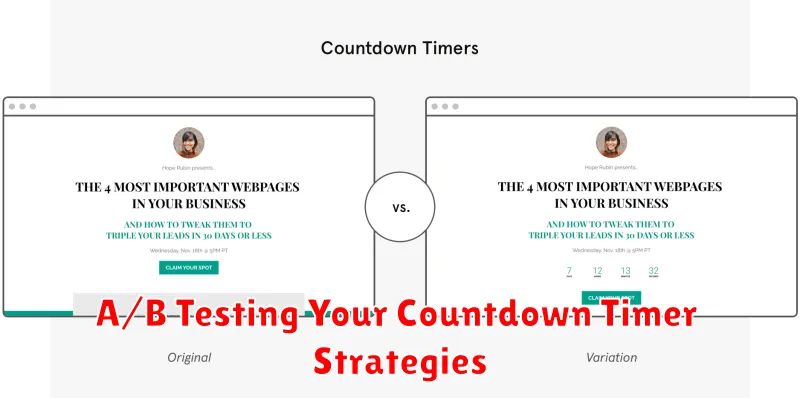
A/B testing is crucial for optimizing your countdown timer strategy. It allows you to compare different approaches and identify what resonates best with your audience. This data-driven approach helps you make informed decisions about timer placement, design, and messaging.
Test different timer durations. A shorter timer might create a stronger sense of urgency, while a longer one could be more suitable for higher-priced items. Compare the conversion rates for each duration to find the sweet spot.
Experiment with timer placement. Consider placing timers on product pages, category pages, or even in pop-up banners. Track which location yields the highest click-through and conversion rates.
Vary the timer’s design and messaging. Test different colors, fonts, and wording to see which combination captures attention and motivates action. For example, compare a simple “Sale Ends In:” message with a more persuasive one like “Don’t Miss Out: Limited-Time Offer!”
By consistently A/B testing your countdown timer strategies, you can refine your approach and maximize their effectiveness in driving sales.
Measuring the Impact of Countdown Timers on Sales
Accurately measuring the impact of countdown timers requires a data-driven approach. Key Performance Indicators (KPIs) provide the insights needed to understand their effectiveness.
Track the conversion rate for products or services featuring countdown timers. Compare this to the conversion rate of identical offerings without timers to isolate the timer’s influence. A noticeable lift in conversions suggests the timer is creating positive urgency.
Monitor the average order value (AOV). If customers with active timers tend to purchase more items or higher-priced options, it indicates the timer might be encouraging larger purchases. Analyze revenue generated specifically from products or pages with countdown timers to quantify their direct impact on sales.
Use platform analytics or A/B testing tools to gather this data effectively. Regularly analyze the results to refine timer strategies and maximize their positive impact.
Avoiding Common Countdown Timer Mistakes
While countdown timers can be highly effective, misusing them can damage your credibility and annoy customers. Avoid these common pitfalls:
Running Timers Constantly
Overusing timers makes them lose their impact. Customers quickly realize the urgency is artificial if every product has a perpetually ticking clock. Reserve timers for special promotions and limited-time offers.
Fake Deadlines
Never use fake deadlines. If the offer doesn’t truly expire when the timer ends, customers will lose trust. Be honest and transparent about your promotions.
Poor Timer Placement
Ensure your timer is clearly visible but not intrusive. A poorly placed timer can disrupt the user experience and detract from the product itself.
