
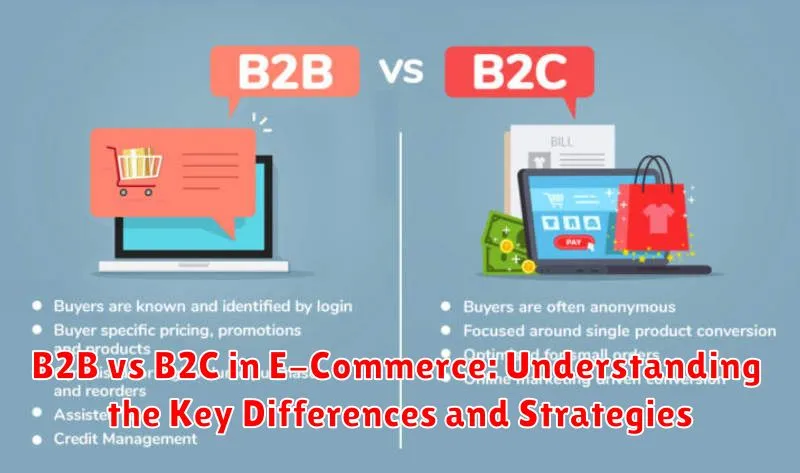
Navigating the world of e-commerce requires a keen understanding of the distinct dynamics between Business-to-Business (B2B) and Business-to-Consumer (B2C) operations. While both involve selling products or services online, their target audiences, sales cycles, marketing strategies, and overall approaches differ significantly. This article delves into the core distinctions between B2B e-commerce and B2C e-commerce, providing valuable insights for businesses seeking to optimize their online presence and achieve success in their respective markets. Understanding these differences is crucial for tailoring e-commerce strategies, developing effective marketing campaigns, and ultimately driving sales.
Whether you are a seasoned e-commerce professional or just starting your online venture, grasping the nuances of B2B vs B2C is paramount. From the initial stages of customer acquisition to post-sales customer relationship management (CRM), the strategies employed vary considerably. We will explore these variations, highlighting best practices for both B2B and B2C models. By examining key aspects such as pricing strategies, content marketing approaches, and sales processes, this article equips businesses with the knowledge to make informed decisions and thrive in the competitive landscape of e-commerce.
Defining B2B and B2C E-Commerce
Business-to-business (B2B) e-commerce refers to online transactions conducted between businesses. This typically involves the sale of products, services, or software from one company to another. B2B transactions often support the operations, production, or resale activities of the purchasing business.
Business-to-consumer (B2C) e-commerce, on the other hand, involves transactions between a business and individual consumers. This is the more familiar form of e-commerce, encompassing online retail sales of goods and services directly to end-users. B2C transactions focus on satisfying personal needs or desires.
Key Differences in Target Audience and Buying Behavior
B2B and B2C e-commerce differ significantly in their target audiences and buying behaviors. B2B targets businesses, focusing on professional buyers making purchasing decisions for their organizations. These decisions are often driven by logic, ROI, and efficiency improvements. B2C, on the other hand, targets individual consumers driven by personal needs and wants. Their purchases are often emotionally driven and influenced by factors like brand image and personal preferences.
The buying process also varies. B2B transactions often involve multiple stakeholders and a longer, more complex decision-making process. B2C purchases are typically simpler and faster, with fewer individuals involved. Order size and frequency also differentiate the two models. B2B often involves larger orders and recurring purchases, while B2C orders are typically smaller and less frequent.
Marketing Strategies for B2B and B2C
B2B marketing often focuses on building relationships and demonstrating value through content marketing, webinars, and industry events. Content marketing plays a crucial role in establishing thought leadership and providing valuable information to potential clients. Direct sales and account-based marketing are also common strategies, targeting specific key accounts within organizations.
B2C marketing, on the other hand, relies heavily on creating emotional connections with consumers through engaging content and targeted advertising on social media and search engines. Strategies often focus on building brand awareness and driving immediate sales through promotions, discounts, and influencer marketing. Personalization is a key element, tailoring messages and offers to individual consumer preferences.
Sales Cycles and Customer Relationships
B2B sales cycles are typically much longer than B2C. B2B purchasing decisions often involve multiple stakeholders and require careful evaluation, negotiation, and approvals. This can result in a sales process that spans weeks or even months. Conversely, B2C sales cycles are often short and transactional, with customers making quick purchase decisions based on immediate needs or desires.
Customer relationships also differ significantly. B2B businesses often prioritize building long-term relationships with clients. These relationships are built on trust, mutual benefit, and ongoing communication. Personalized service, dedicated account managers, and tailored solutions are common in B2B. B2C relationships, on the other hand, tend to be more transactional and less personalized. While building customer loyalty is important, the emphasis is often on acquiring new customers and driving individual sales.
Technology and Platform Considerations for B2B and B2C
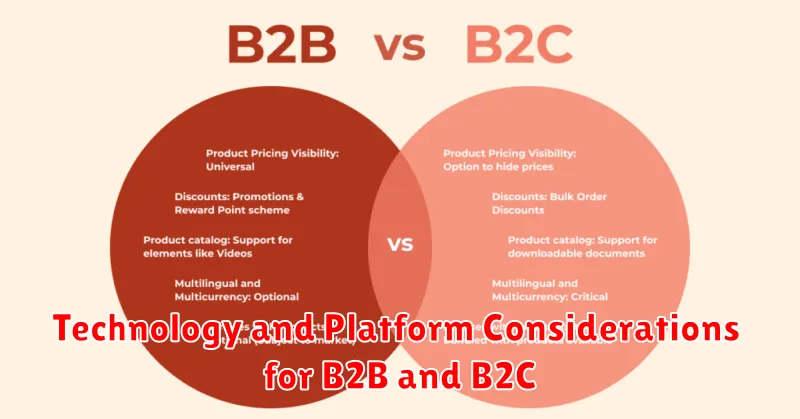
Technology and platform choices differ significantly between B2B and B2C e-commerce. B2C platforms prioritize ease of use and a streamlined checkout process for individual shoppers. B2B platforms often require more complex features.
B2B platforms often integrate with existing enterprise resource planning (ERP) systems. This integration streamlines order processing, inventory management, and customer relationship management (CRM). Such integration allows for automated data exchange and reduces manual data entry. It contributes to greater efficiency and accuracy.
Customization is another key consideration. B2B platforms need to support customized pricing, product catalogs, and payment terms. These reflect the unique needs of different business clients. Conversely, B2C platforms typically offer standardized pricing and product configurations to a broader audience.
Security is paramount for both B2B and B2C. However, B2B transactions often involve larger sums and sensitive data, necessitating robust security measures. These measures might include multi-factor authentication and advanced encryption to protect against cyber threats.
Content Marketing Strategies for B2B and B2C
Content marketing plays a crucial role in both B2B and B2C e-commerce, but the approaches differ significantly. B2B content marketing focuses on building relationships and establishing expertise to drive long-term value. Content often includes white papers, case studies, webinars, and in-depth blog posts addressing complex industry challenges.
B2C content marketing, on the other hand, prioritizes driving immediate sales and building brand awareness. Strategies often involve creating engaging social media content, short videos, lifestyle blog posts, and interactive quizzes. The emphasis is on capturing attention and fostering emotional connections with consumers.
Key differences in content strategy lie in the target audience, purchase cycle, and content format. B2B targets businesses with specific needs and longer decision-making processes, while B2C targets individual consumers with shorter purchase cycles. This influences the chosen format and depth of the content.
Customer Service and Support in B2B and B2C
Customer service and support strategies differ significantly between B2B and B2C e-commerce. B2C customer service typically focuses on resolving individual customer issues quickly and efficiently, often through standardized processes and self-service portals. Speed and accessibility are paramount.
B2B customer service, on the other hand, prioritizes building strong, long-term relationships. Support often involves dedicated account managers who understand the client’s specific business needs. Personalized service, proactive communication, and technical expertise are highly valued.
Response times also vary. B2C customers expect near-instantaneous responses, while B2B clients may accept longer response times for complex inquiries. The level of technical knowledge required also differs. B2C support often addresses simpler product usage questions, whereas B2B support may involve intricate integrations and specialized training.
Measuring Success in B2B and B2C E-Commerce
Measuring e-commerce success requires distinct approaches for B2B and B2C businesses due to their differing target audiences and sales cycles. Key Performance Indicators (KPIs) vary significantly.
In B2C, emphasis is placed on metrics like conversion rate, average order value (AOV), and customer lifetime value (CLTV). Analyzing website traffic, bounce rates, and cart abandonment rates provides insights into customer behavior and areas for improvement. Social media engagement and customer reviews also play a crucial role in gauging brand perception and customer satisfaction.
B2B success measurement focuses on different metrics. Lead generation, sales cycle length, and customer churn rate are paramount. Analyzing customer acquisition cost (CAC) and return on investment (ROI) of marketing campaigns is essential for optimizing resource allocation. Furthermore, tracking key account performance and contract renewal rates provides insights into long-term business relationships.
Future Trends in B2B and B2C E-Commerce
Both B2B and B2C e-commerce landscapes are constantly evolving. Staying ahead of the curve requires understanding emerging trends.
B2B Trends
Personalization is becoming increasingly important in B2B. Tailored experiences and product recommendations will enhance customer satisfaction and drive sales. AI-powered platforms will further automate processes, improving efficiency in areas like procurement and supply chain management. The rise of B2B marketplaces will connect businesses with suppliers more effectively, streamlining purchasing processes.
B2C Trends
Augmented and virtual reality (AR/VR) are poised to revolutionize the online shopping experience, enabling customers to virtually “try before they buy.” Social commerce will continue to blur the lines between social media and online shopping, allowing consumers to purchase products directly through social platforms. Hyper-personalization using sophisticated data analysis will deliver even more targeted product recommendations and marketing messages, enhancing customer engagement.
