

In today’s competitive e-commerce landscape, providing a personalized customer experience is no longer a luxury, but a necessity. Personalized product recommendations are a powerful tool for online businesses seeking to enhance customer engagement, drive sales, and foster long-term loyalty. This article explores the significant impact of personalized product recommendations on e-commerce success, outlining strategies for implementation and highlighting best practices for maximizing their effectiveness. Understanding how to leverage the power of personalized recommendations is essential for any e-commerce business aiming to thrive in the modern market.
By leveraging data-driven insights and sophisticated algorithms, businesses can deliver highly tailored product suggestions that resonate with individual customer preferences. From increasing conversion rates and average order values to improving customer retention and driving repeat purchases, personalized product recommendations offer a multitude of benefits. Unlocking this potential requires a strategic approach to data collection, analysis, and implementation. This article will guide you through the key steps to effectively utilize personalized product recommendations and achieve e-commerce success.
Understanding the Importance of Personalized Recommendations
In today’s competitive e-commerce landscape, personalized product recommendations are no longer a luxury, but a necessity. They serve as a powerful tool for enhancing the customer experience and driving business growth. By offering tailored suggestions, businesses can effectively cater to individual customer preferences, leading to increased engagement and conversions.
Personalized recommendations address the overwhelming choice often presented to online shoppers. Instead of sifting through countless products, customers are presented with items specifically curated for them, simplifying the buying process and saving valuable time. This improved user experience fosters a sense of being understood and valued, cultivating customer loyalty and encouraging repeat purchases.
Furthermore, personalized recommendations are crucial for boosting sales. By showcasing relevant products, businesses can effectively cross-sell and upsell, increasing average order value and overall revenue. This targeted approach minimizes wasted marketing efforts by ensuring that promotions reach the right audience, maximizing their impact.
Data Collection Methods for Personalized Recommendations
Effective personalized product recommendations rely on robust data collection. Gathering pertinent information about customer behavior and preferences is crucial for building accurate profiles.
Several key methods enable this data collection. Explicit data collection involves directly asking customers for information, such as through preference centers or surveys. This allows for a clear understanding of stated interests. However, response rates can be low.
Implicit data collection, on the other hand, observes customer behavior without direct interaction. This includes tracking browsing history, purchase history, and product interactions like adding items to carts or wishlists. Implicit data offers valuable insights into actual customer behavior, though interpretations may require more analysis.
Combining both explicit and implicit data provides a more comprehensive view of individual customers, leading to more effective personalization strategies.
Leveraging Customer Data for Effective Personalization
Collected customer data becomes a powerful tool for creating truly personalized shopping experiences. Analyzing this data allows businesses to understand individual customer preferences, predict future behavior, and tailor recommendations accordingly. This process involves more than simply suggesting popular items; it’s about offering products relevant to each shopper’s unique needs and interests.
Segmentation plays a key role in leveraging customer data. By dividing customers into groups based on shared characteristics (demographics, purchase history, browsing behavior), businesses can create targeted recommendations for each segment. This ensures that the recommendations resonate with the specific needs and interests of each group.
Furthermore, real-time data analysis allows for dynamic personalization. Tracking current browsing activity and incorporating it into the recommendation engine enables businesses to offer products related to what a customer is actively viewing, significantly increasing the likelihood of conversion.
Types of Personalized Product Recommendations
E-commerce businesses utilize various recommendation systems to tailor product suggestions to individual customer preferences. Understanding these different types is crucial for maximizing their impact.
Content-Based Filtering
This method suggests products similar to what a customer has interacted with previously. If a customer views a specific running shoe, the system might recommend other running shoes with similar features or from the same brand.
Collaborative Filtering
This approach analyzes user behavior across a broader customer base. It identifies users with similar purchasing patterns and recommends products they have purchased that the target customer hasn’t yet explored.
Popularity-Based Recommendations
This simple method suggests products that are currently trending or best-selling across the platform. While not strictly personalized, it can still be effective for introducing new arrivals or highlighting popular choices.
Hybrid Approaches
Many businesses leverage a combination of methods, such as merging content-based filtering with collaborative filtering, to offer more nuanced and relevant product recommendations.
Implementing Personalized Recommendations on Your Website
Implementing a personalized recommendation engine involves several key steps. First, choose the right recommendation engine. Several options exist, from open-source solutions to sophisticated SaaS platforms. Consider factors like scalability, ease of integration, and customization options when making your selection.
Next, integrate the chosen engine with your existing e-commerce platform. This often involves working with APIs and ensuring data flows seamlessly between systems. Thorough testing is crucial to ensure accurate recommendations and avoid disruptions to your website’s functionality.
Displaying recommendations strategically maximizes their impact. Consider placement on product pages, the homepage, during checkout, or even in personalized emails. A/B testing different placements and presentation styles can help optimize for conversions.
Finally, monitor and refine your recommendation engine’s performance. Track key metrics like click-through rates, conversion rates, and average order value. Regularly analyze this data to identify areas for improvement and adjust recommendation strategies accordingly.
Best Practices for Successful Product Recommendations
Implementing personalized product recommendations requires a strategic approach. Data quality is paramount. Ensure your data is clean, accurate, and up-to-date to avoid irrelevant recommendations. This includes accurate product categorization and customer profiles.
Segmentation is key. Divide your customer base into distinct groups based on shared characteristics, like purchase history, demographics, or browsing behavior. This allows for more targeted and relevant recommendations.
Testing and optimization are crucial for ongoing success. A/B test different recommendation strategies, algorithms, and placements to determine what resonates best with each customer segment. Continuously analyze results and adjust your approach accordingly.
Transparency and control build customer trust. Explain how recommendations are generated and offer users the ability to adjust their preferences or opt-out entirely. This empowers customers and fosters a positive user experience.
Measuring the Impact of Personalized Recommendations

Tracking the effectiveness of personalized product recommendations is crucial for optimizing their performance and demonstrating their value. Key Performance Indicators (KPIs) provide quantifiable metrics to assess the impact of these recommendations on your e-commerce business.
Some important metrics include:
- Click-Through Rate (CTR): Measures how often customers click on recommended products. A higher CTR indicates greater customer engagement with the recommendations.
- Conversion Rate (CVR): Tracks the percentage of clicks that result in a purchase. This metric reveals how effective recommendations are in driving sales.
- Average Order Value (AOV): Calculates the average amount spent per order. Personalized recommendations can increase AOV by suggesting relevant, higher-priced items.
- Revenue Per Visitor (RPV): Measures the revenue generated per website visitor. This KPI helps assess the overall impact of recommendations on revenue generation.
By regularly monitoring these KPIs, businesses can fine-tune their recommendation strategies to maximize their impact on customer behavior and overall business performance.
Examples of Effective Personalized Product Recommendation Strategies
Several strategies effectively leverage personalized product recommendations. Product-based collaborative filtering analyzes past purchases to suggest similar items. For example, if a customer buys a specific camera, the system might recommend compatible lenses or tripods.
Content-based filtering focuses on product attributes. If a customer views several running shoes, the system could recommend other running shoes with similar features like cushioning or support. Demographic-based filtering uses customer characteristics like age or location. A retailer might recommend age-appropriate toys or clothing based on customer demographics.
Hybrid approaches combine techniques for a more nuanced approach. This could involve blending collaborative filtering with content-based filtering to suggest items both similar to past purchases and matching current interests. Furthermore, real-time personalization leverages immediate browsing behavior to offer highly relevant recommendations during the shopping session.
Future Trends in Personalized Product Recommendations
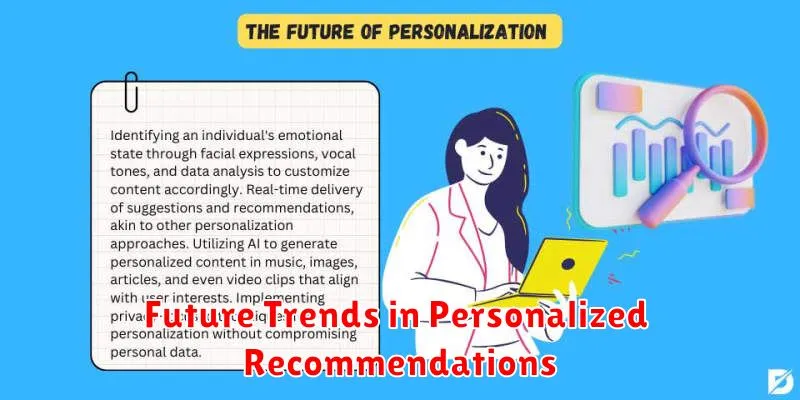
The landscape of personalized product recommendations is constantly evolving. Several key trends are poised to shape the future of this crucial e-commerce tool.
AI-Powered Hyper-Personalization will move beyond basic demographics and purchase history. Sophisticated algorithms will analyze real-time data, including social media activity, browsing behavior, and even contextual information like weather or location, to deliver incredibly tailored recommendations.
Contextual Awareness will play a larger role. Recommendations will be sensitive to the user’s current needs and situation. For instance, a customer browsing on their mobile device while commuting might see different recommendations compared to when browsing at home on their desktop.
Omnichannel Personalization will ensure a seamless experience across all touchpoints. Recommendations delivered in-store, via email, or through social media will be consistent and relevant to the individual customer’s preferences.
Increased Transparency and Control will empower users with more insight into why specific products are recommended. Giving customers the ability to adjust their privacy settings and influence the recommendation engine will build trust and enhance the user experience.
